




In January 2025, the U.S. administration announced a temporary suspension of nearly all aid programs funded by the Department of State and USAID. This decision – part of a new political strategy – also affected projects implemented in Poland, which in 2024 alone amounted to approximately 200 million PLN. These funds played a key role in humanitarian and integration activities for war refugees from Ukraine. In response to the situation, the Mapuj Pomoc Network (Sieć Mapuj Pomoc) conducted a survey in cooperation with The Ukraine Foundation (Fundacja Ukraina), Q Foundation (Fundacja Q), Polish Migration Forum (Polskie Forum Migracyjne), Nomada Association (Stowarzyszenie Nomada), and Towards Dialogue Foundation (Fundacja w Stronę Dialogu). The aim was to assess the scale of the impact of donor decisions on Polish NGOs, including the risk of disrupted continuity of services, the effect on vulnerable groups, and the need for systemic support from public institutions in Poland.
About the Survey
The survey was conducted online between April 22 and May 6, 2025. The research tool was developed by the Mapuj Pomoc Network, working in partnership with the organizations mentioned above. A total of 24 NGOs working with migrants and refugees in Poland took part. The questionnaire included both closed and open-ended questions, allowing the collection of both quantitative and qualitative data. Respondents indicated, among other things, sources of funding, geographic scope of projects, scale of financial losses, at-risk activities, staffing impacts, and effects on beneficiaries.
Scale of Financial Losses
The total declared loss resulting from the freeze of U.S. funds by surveyed organizations amounted to nearly 18 million PLN. The average loss per organization exceeded 1 million PLN, but the median – i.e., the middle value – was around 400,000 PLN, indicating significant variation. Some organizations reported relatively small losses, while others experienced massive ones – up to over 7.5 million PLN. These figures show that the loss of funding was not uniform and largely depended on the scale of operations and financial models of individual NGOs.
Most Affected Activities
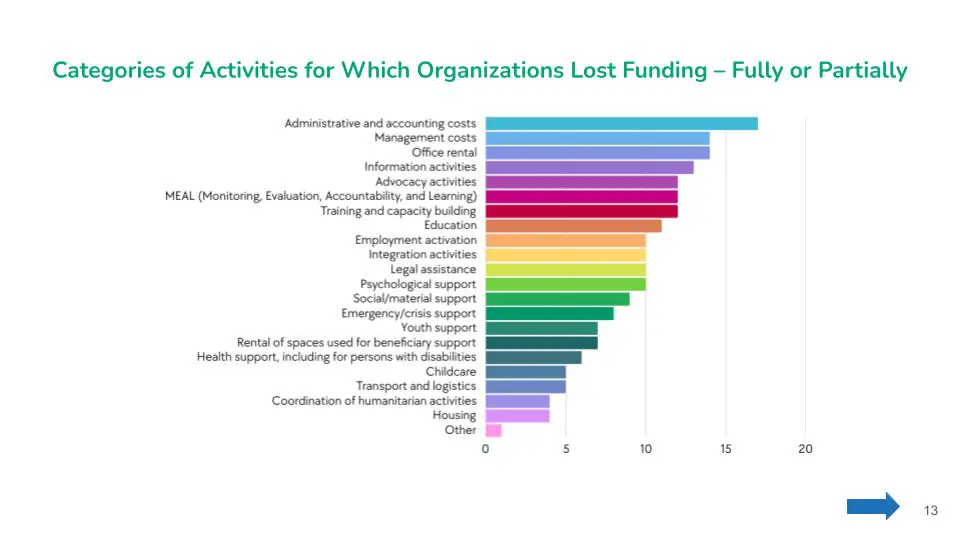
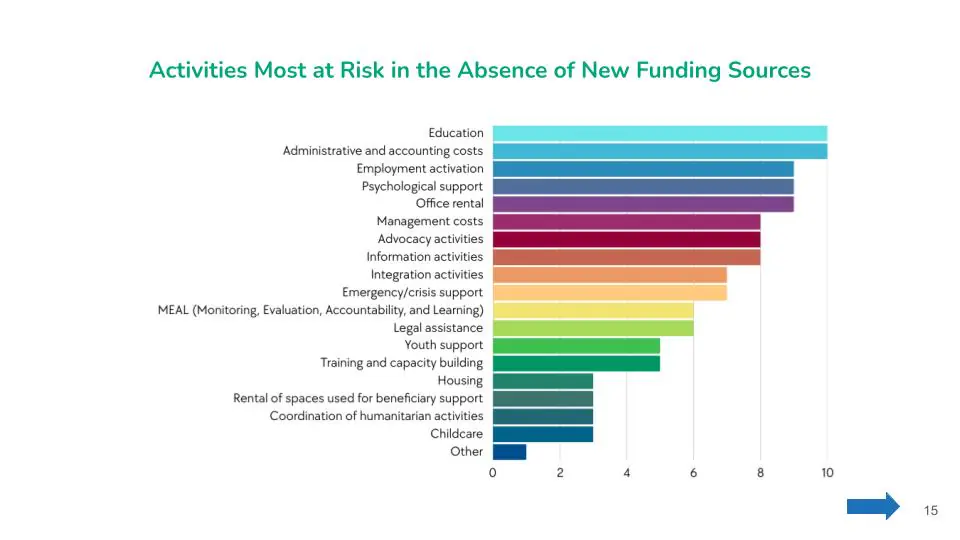
The funding freeze impacted both core operational costs and activities directly aimed at beneficiaries. The most frequently reported at-risk or suspended areas were administrative and accounting costs, office rental, and management. In terms of programmatic and substantive activities, the most affected areas included education, psychological support, legal aid, professional activation, as well as integration and advocacy efforts. Respondents emphasized that even relatively small percentages of lost funding were enough to paralyze certain specialized programs.
Impact on Beneficiaries and Vulnerable Groups
The study showed that the consequences of the funding suspension affected a broad group of beneficiaries – an estimated 125,000 people may have already lost or may soon lose access to support. Vulnerable groups – such as children, women with children, the elderly, and people with disabilities – were particularly at risk. As many as 75% of organizations confirmed that their suspended programs were primarily targeted at such groups, highlighting the risk of deepened social exclusion and marginalization.
Staffing Impacts
More than half of the surveyed organizations (58%) confirmed that the loss of funding resulted in staff reductions. In some cases, up to 100% of staff were at risk of being laid off. In many organizations, remaining employees took on the responsibilities of multiple people, increasing the risk of burnout and team destabilization. Staffing cuts negatively affect the ability of organizations to carry out their core missions and maintain the quality of services provided.
Geographic Reach of the Problem
The funding freeze had a nationwide impact. Affected projects were being implemented in all Polish voivodeships, with the highest concentration in Mazowieckie and Małopolskie – regions known for intense humanitarian activity.
Recommendations
Based on the survey results, organizations call for the following actions:
- Strengthening communication with organizations affected by the funding crisis
Coordinated efforts between the sector and the government are essential to present the real effects of the staffing and financial crisis on the social support system. This includes information campaigns, meetings with institutional partners, and analytical reports that can help develop appropriate responses. - Establishment of a bridging or emergency fund
This fund should reflect the financial needs of organizations supporting vulnerable groups and allow for the continuation of key activities until new resources are secured. It should cover staff salaries, operational costs, and essential services. The grant scheme should feature simplified reporting procedures and be accessible to smaller organizations. - Prioritization of support for organizations assisting highly vulnerable groups
Continuity of operations should be guaranteed, especially in areas critical to the protection of people at risk of exclusion, such as refugees, women, children, and persons with disabilities. Maintaining these services is vital to upholding human rights and social stability. - Mapping service provision gaps
A thorough analysis is recommended to identify the most affected areas and social groups in terms of access to support. This will help direct emergency efforts and support to the most impacted organizations. It is also necessary to maintain existing hotlines and information portals that provide reliable, up-to-date assistance. - Investment in organizational resilience
In the long term, efforts should focus on developing crisis planning capacity, diversifying funding sources, and professionalizing NGO management. It is recommended to introduce dedicated training and mentoring programs to help organizations better respond to crises and strengthen their stability.
Access the Full Survey Results
We invite you to review the full survey results in the presentation linked below.