



The report “In Search of Safe Harbor – Mapping Update” published by the To Proste Foundation (Mapuj Pomoc) team, presents the results of a mapping of collective accommodation centers (CCs) for refugees from Ukraine conducted in cooperation with the International Organization for Migration (IOM).
GOAL OF THE PROJECT
The purpose of the survey was to verify and update information on the operation of collective accommodation centers in Poland in connection with the amendment of the special act on July 1, 2024. In particular, data was collected to determine:
- how many and which centers are still operating after the regulatory change, and which have been closed,
- how the changes affected centers previously funded under Article 13 and those with fewer than 10 residents,
- mapping of new centers that signed a contract with the governor after July 1, 2024.
METHODOLOGY
From September to December 2024, the Mapuj Pomoc team collected detailed information on the operation of the CCs during telephone interviews with center coordinators. Included were data on the number of available places, the number of people residing in the center, the gender and age of the residents, the number of people exempted from participation fee, adaptation of the center to the needs of people with disabilities, additional forms of support available at the facility, representatives of ethnic and national minorities, sources of funding for the center, and others.
KEY FINDINGS
The number of collective centers is gradually decreasing
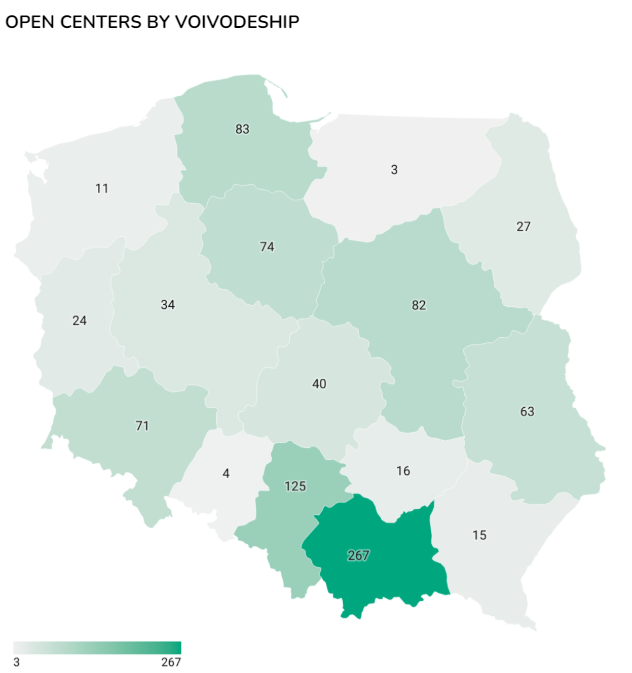
In each voivodeship, between June and December 2024, from a few to a few dozen CCs were closed. A total of 132 centers ceased to operate. At the end of December, 939 CCs were reported to be operating. The largest number of active centers is in the Małopolskie, Śląskie, Pomorskie and Mazovieckie voivodeships.
Support for groups with special needs
Residents of the centers are often people from vulnerable groups. Children and adolescents account for 40% of CCs residents. One in five CCs residents is an elderly person (over 60). Approx. 7% of residents are people with disabilities. In almost one in ten centers, residents represent ethnic and national minorities.
Differences in the quality of accommodation and availability of additional services
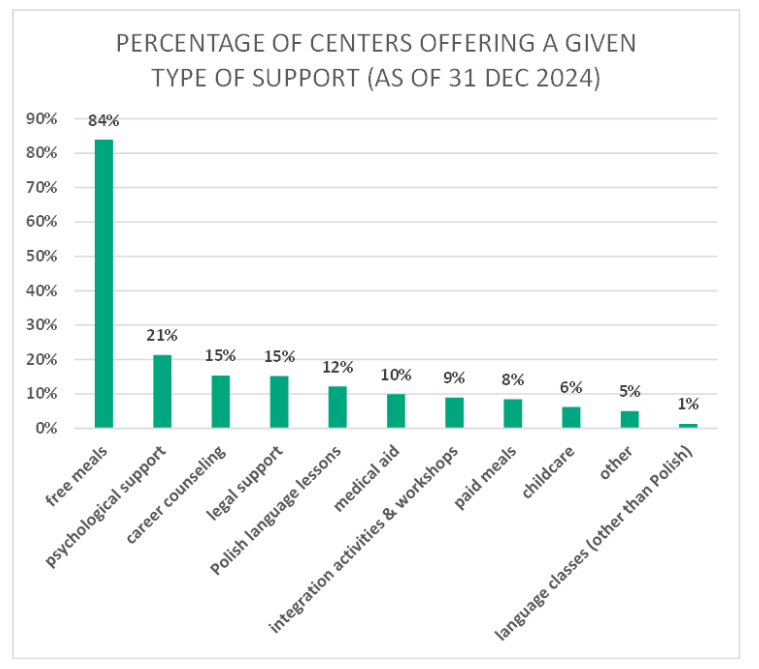
The centers vary in the quality of accommodation they provide – there are no unified standards. In only one in five centers are additional forms of support, other than food, available. There are not enough activities to support social integration, language learning and contact with the local community. Psychological support can be received in 21% of the CCs, and career counseling and assistance in finding a job is available in 15% of the centers.