“Lessons from Crisis” is the result of broad, cross-sector collaboration involving more than 60 civil society organizations, experts, institutional partners, and local governments operating within the Mapuj Pomoc Network. Strategic support was provided by the ORLEN Foundation and PZU, including PZU Życie.
As a community of organizations gathered around the Crisis Management Group, engaged in relief efforts for people affected by the floods and the refugee crisis between 2022 and 2025, we decided to systematize and share the operational knowledge and experience we have gained.
Since April 2025, together with representatives of more than 60 civil society organizations from across Poland, and in cooperation with UN agencies (UNHCR, IOM, WHO, UNICEF), local government units, business partners, public institutions, as well as experts, we have been conducting an intensive process of analyzing the lessons learned from recent crises.
In this publication, we have compiled the key challenges we faced in practice, along with recommendations and proven solutions that enabled us to respond effectively to rapidly changing circumstances. This document serves as a compendium of knowledge based on real-life action and cross-sector collaboration.Chair of the Mapuj Pomoc Network, Monika Miłowska
The handbook was developed primarily for staff and representatives of small and medium-sized civil society organizations, as well as local leaders.
They are the people working closest to local communities, who in situations of sudden crisis often take on responsibilities that go beyond their everyday roles and formal competencies. Guided by concern for the safety and well-being of people, they make rapid decisions and organize support where it is needed most.
Even if they are not involved in logistics, warehouse management, or the coordination of aid distribution in their daily work, in times of crisis they become key links in the local support system.
What will you find in the publication?
The handbook covers ten key areas of crisis response activities, including warehouse management, organizing aid collection and shipments, and the effective distribution of support, as well as legal, psychological, and housing assistance. It also addresses issues related to education, integration, and childcare. In addition, the publication explores cross-cutting topics such as support for vulnerable groups, safeguarding, volunteer coordination, and data collection and management.
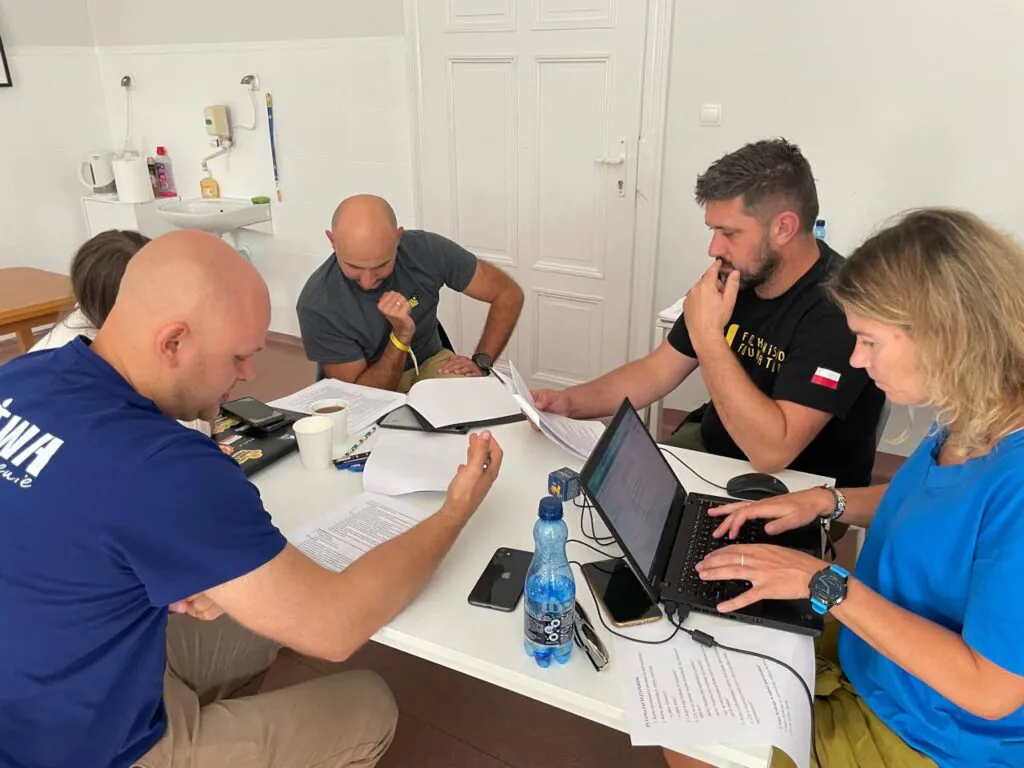
Each of these areas was developed over a period of more than six months by working groups operating under the guidance of a facilitation team and with the support of thematic leads. The meetings were held on a regular, monthly basis. The aim of this work was to identify key challenges, highlight the most common mistakes, and develop recommendations based on practical experience and real operational practice.
Who developed the document?
The compiled recommendations are the result of several months of joint work by the Crisis Management Group within the Mapuj Pomoc Network.
Strategic partners: PZU and ORLEN Foundation.

Organization and editorial work: Mapuj Pomoc Network.
Content partners: Centre for Disasters and Natural Hazards TRATWA, Migrant and Refugee Assistance Centre at Caritas of the Archdiocese of Katowice, Comtegra, Dom Otwarty, Akceptacja Foundation, Folkowisko Humanitarian Foundation, JRS Poland Foundation, Kordon Foundation, Save the Children Poland Foundation, To Proste Foundation, Ukraina Foundation, Z Wyboru Foundation / The Presja, Lokalny Fundusz Masywu Śnieżnika, HumanDoc, International Organization for Migration Poland, Security Observatory, Polish Humanitarian Action, ArteWeda Association, Kłodzka Wstęga Sudetów Association, Friends of the Lądek-Zdrój Region Association.
Partners: The Salvation Army, Food Bank in Olsztyn, Dwa Skrzydła UA, ADRA Poland Foundation, Dobra Fabryka Foundation, Social Education Foundation, International Rescue Committee Poland Foundation, Lena Grochowska Foundation, BARKA Mutual Aid Foundation, Project HOPE Poland Foundation, Foundation Towards Dialogue, CARE International in Poland Foundations, Institute for Heritage Security, Centre of Migration Research at the University of Warsaw, Polish Red Cross, Polish Centre for International Aid (PCPM), Plan International Poland, Rotary Club Jelenia Góra, Ukrainian House, UNHCR.
Honorary patronage: Deputy Chair of the Committee for Public Benefit.
- The publication was funded by the ORLEN Foundation and the preventive fund of PZU.
Why download this publication?
We believe that this document can serve as a practical guide both in emergency situations and in everyday preparedness activities. An effective response system is only possible through cross-sector cooperation based on dialogue, partnership, and shared responsibility — so that no person in need of support is left behind.
Lessons from Crisis:
- clarify the principles of cooperation with public administration and emergency services.
- show how to prepare procedures in advance.
- suggest how to avoid mistakes that emerged in previous crises.
- include ready-to-use solutions that can be implemented without legal changes.
- present how other organizations addressed specific challenges.
Want to learn more?
Contact the coordinator of the Crisis Management Group to discuss how the recommendations can be implemented in your organization or local community.
Karolina Chojka-Bartoszko
karolina.ch.bartoszko@toproste.org